Updates on Christina
Hi everyone! This is where I’ll be posting updates on Christina’s health while she is in NICU. If you got here for the first time, feel free to scroll down to the Summary to get caught up with what’s going on. I’ll try to post an update every day as we track her progress.
Monday Feb 23rd
Doctor called at 8 am to let us know Christina vomited bile again at around 3 am. Her belly size also went up again. Like the first day, they stopped the feeding and put the suction tube back in her mouth. By 7 am or so, her belly had gone back down in size and the x-ray showed she didn’t have much air in her intestines, but still had some meconium. She was back to stable condition, but failed the feeding test, so we had to reassess approach.
Later that day, the general pediatric surgeon visited her to analyze the situation further. The surgeon recommended the following protocol:
- Give her some rectal irrigations (a saline enema) and a repository to help her flush the meconium and estimulate her colon
- Re-start the feeding protocol starting with 5 ml. This time she will be fed through the same tube used to suck out air, to make sure there’s no extra air going on from bottle or breastfeeding.
- If she fails the feeding test again, repeat the Barium X-ray to flush further, and compare the left the colon size to the first X-ray
This means her entire NICU stay is pushed back another 4-5 days more while they go through all these tests. But I agree with recommendations! Some doctors recommend doing the rectal biopsy to diagnose Hirschsprung’s right after the first feeding test failure. However, this has the risk of misdiagnosing the baby if her ganglia are still a bit underdeveloped or not as populated. It is better for us to stay patient, even if it’s a little slower, and try again the entire process from the beginning. We don’t want to diagnose her with a condition and even do a Colostomy that is not necessary, which is a mistake that has happened in the past in patients!
If the Barium X-ray shows her left colon is still the same size, then it may increases the likelihood it is Hirschsprung’s we are dealing with, so only at this point we will likely recommend doing the rectal biopsy to confirm or discard the possibility.
We will let you know how the test goes!
Sunday Feb 22nd
After her Barium X-ray, Christina has continued pooping a couple times, so the doctor decided to begin the food testing. She was fed 5 ml of breastmilk at 3 pm and 6 pm. Doctor said we could also try direct breastfeeding, so at 9 pm we visited her and Priscilla had the chance to feed her directly! She took as much as she could from one breast, and rejected the other. The nurse offered her another 5 ml via bottle to make sure she wasn’t hungry, and she took it. We will now begin monitoring her pooping and belly size to make sure she doesn’t get plugged or bloated again,
Summary
First things first: despite being in NICU, Christina’s condition is stable and non-life threatening. She is NICU because it provides the best place for her to be in the hospital under doctor’s care, not the seriousness of her condition. She has a private room that Mom and Dad can visit as many times as we want, 24/7. She stays in a temperature-controlled box most of the time, but when we visit we can request for her to be taken out to be carried and have skin-to-skin time with Mom. So even when there are days that don’t have a super positive update, it’s all in the context of a very manageable situation! Now unto the details…
Christina was taken to the NICU about 30 hours after birth because she failed to have her first poop of the tar-like material called meconium AND throwing up bile. Her belly was “distended”, meaning it was hard to the touch as if bloated. An initial x-ray revealed she had lots of air and meconium bits stuck in her intestines, but nothing making it to her rectum. She was effectively “plugged”. Doctors connected a small tube through her mouth and into the stomach to slowly suck out the air, which is the standard treatment for this problem. She was also unable to eat in order to give her digestive system a chance to recover. She has an IV that gives her all of the electrolytes, sugar, fats, and protein she needs even without taking in breastmilk! After staying in the NICU overnight, she was able to start pooping the first bits of meconium.
Christina’s entire NICU stay is about figuring out why her intestines were plugged, so that we can all be sure she can eat and poop normally without any issues. If she gets plugged again and goes unnoticed for a long time, her intestines can be ruptured, and her life severely threatened. This is why this entire process can feel a little slow! We need full certainty that her digestive system is working as intended, so she can go home safe and sound. The standard process for these type of issues is to start giving a small amount of food each feeding and observing her belly and poop status. If she passes one stage, they increase the food a bit, and observe. They will keep doing this over 3-4 days until she reaches about 20ml of breastmilk per feeding. If she passes that, she can go home. If she fails any stage, we have to stop the test, see if we can figure out what happened, and try again for the beginning. That means stopping the food for about a day to let her system rest, and then start over with the feeding, from the initial dose if needed. This is why she may be in NICU for many days. Digestive issues require a lot of patience and slow testing, but her condition is perfectly stable throughout.
What do we think is causing her issues? By now we have narrowed it down to 2 possibilities:
Neonatal Small Left Colon Syndrome (Current Diagnosis)
As of today, this is the current diagnosis for Christina.
This is a condition where a baby’s left colon (the part that takes the food, converts it to poop, and transports it down to the anus) is underdeveloped, so it cannot move remains efficiently outside the body. The way she was diagnosed is via a Contrast X-Ray, which is also the treatment! What they do is inject a milky liquid (Barium) through her rectum which “shines” in an x-ray and lets doctors see the exact shape of her entire digestive system (example). The liquid does two things: allows doctors to see her intestine, but also serves as an “enema” that flushes out whatever is stuck in there. Christina had her first Barium enema in her second day at the NICU, and the results clearly show the smaller left colon.

The good news is that this condition requires no medicine or surgery; it goes away on its own as the colon finishes growing after birth. At best, it can be a couple days, and at worst, 1-2 weeks. The only thing we can do is do the food test, giving her a bit each day and seeing if the colon is working correctly.
Hirschsprung’s Disease
This is the “worst-case scenario” but still manageable. Doctors don’t believe this is what’s causing her problems, so I won’t write much about it, but we haven’t completely ruled it out yet. In short, this is a disease where a part of the colon does not work (and will never work) correctly because of some nerves cells called ganglia in the colon wall that never developed. That creates a “dead zone” in the colon where nothing can naturally pass through.
The way to diagnose HD is via a rectal biopsy, where they take a small shaving off her intestine wall (wherever the dead zone is) and look at it under a microscope to see if it has missing ganglia
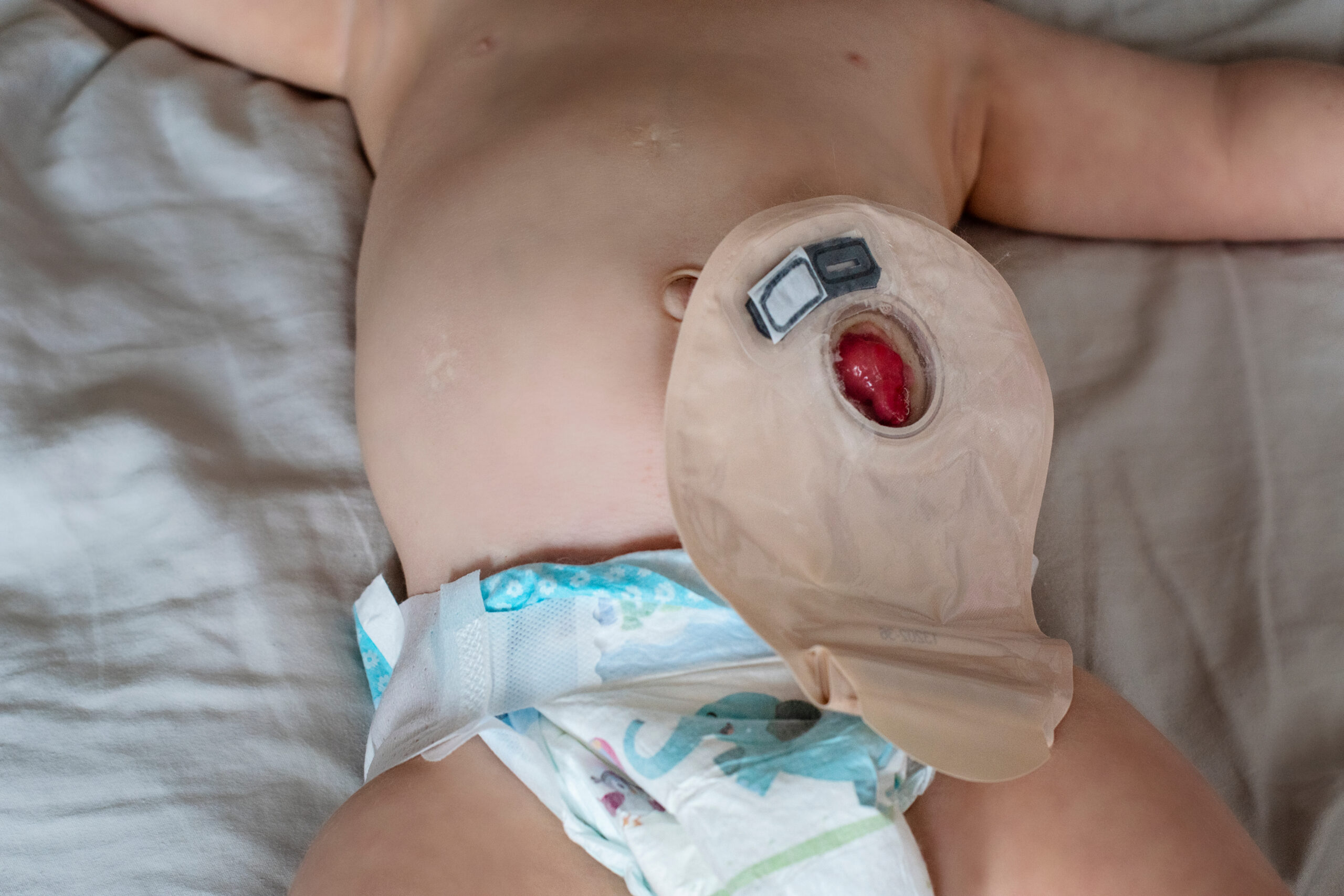
The solution for HD is surgery. They cut out the dead zone of the colon and connect the remaining good parts with each other to restore the proper flow. This surgery can be performed later in life (4-6 months) when a baby is stronger and can do better in surgery. In the meantime, the baby is given a Colostomy, which is a small surgery where they expose a good part of the colon via the belly, and attach a bag to collect the poop that cannot make it down to the anus (example).
Actualizaciones sobre Christina
¡Hola a todos! Aquí es donde estaré publicando actualizaciones sobre la salud de Christina mientras está en la UCIN (Unidad de Cuidados Intensivos Neonatales). Si es la primera vez que entras, no dudes en bajar hasta el Resumen para ponerte al día con lo que está pasando. Intentaré publicar una actualización cada día mientras seguimos su progreso.
Lunes 23 de febrero
El doctor llamó a las 8 am para informarnos que Christina volvió a vomitar bilis alrededor de las 3 am. El tamaño de su vientre también aumentó de nuevo. Al igual que el primer día, detuvieron la alimentación y le volvieron a colocar la sonda de succión en la boca. Cerca de las 7 am, su vientre había vuelto a su tamaño normal y la radiografía mostró que no tenía mucho aire en sus intestinos, aunque todavía tenía algo de meconio. Volvió a estar en estado estable, pero falló la prueba de alimentación, por lo que tuvimos que reevaluar el enfoque.
Más tarde ese día, el cirujano pediátrico general la visitó para analizar la situación más a fondo. El cirujano recomendó el siguiente protocolo:
- Darle algunas irrigaciones rectales (un enema de solución salina) y un supositorio para ayudarla a eliminar el meconio y estimular su colon.
- Reiniciar el protocolo de alimentación comenzando con 5 ml. Esta vez será alimentada a través de la misma sonda que se usa para succionar el aire, para asegurar que no entre aire extra por el biberón o el pecho.
- Si falla el protocolo de alimentación de nuevo, entonces repetir la radiografía de bario para limpiar más a fondo y comparar el tamaño del colon izquierdo con la primera radiografía.
Esto significa que su estancia en la UCIN se retrasa otros 4-5 días más mientras realizan todas estas pruebas. ¡Pero estoy de acuerdo con las recomendaciones! Algunos médicos recomiendan hacer la biopsia rectal para diagnosticar Hirschsprung justo después del primer fallo en la prueba de alimentación. Sin embargo, esto conlleva el riesgo de un diagnóstico erróneo si sus ganglios aún están un poco subdesarrollados o no están tan poblados. Es mejor para nosotros mantener la paciencia, incluso si es un poco más lento, e intentar de nuevo todo el proceso desde el principio. ¡No queremos que le diagnostiquen una condición e incluso le hagan una colostomía que no sea necesaria, que es un error que ha ocurrido en el pasado con otros pacientes!
Si la radiografía de bario muestra que su colon izquierdo sigue teniendo el mismo tamaño, entonces aumenta la probabilidad de que se trate de Hirschsprung, por lo que solo en ese punto recomendaremos probablemente hacer la biopsia rectal para confirmar o descartar la posibilidad.
¡Les informaremos cómo sale la prueba!
Domingo 22 de febrero
Después de su radiografía de bario, Christina ha seguido evacuando un par de veces, por lo que el médico decidió comenzar las pruebas de comida. Se le dieron 5 ml de leche materna a las 3 pm y a las 6 pm. El doctor dijo que también podíamos intentar la lactancia directa, así que a las 9 pm la visitamos y ¡Priscilla tuvo la oportunidad de amamantarla directamente! Tomó todo lo que pudo de un pecho y rechazó el otro. La enfermera le ofreció otros 5 ml vía biberón para asegurarse de que no tuviera hambre, y los aceptó. Ahora comenzaremos a monitorear sus deposiciones y el tamaño de su vientre para asegurarnos de que no se obstruya o se hinche de nuevo.
Resumen
Primero lo primero: a pesar de estar en la UCIN, la condición de Christina es estable y no pone en peligro su vida. Está en la UCIN porque es el mejor lugar del hospital para que esté bajo cuidado médico, no por la gravedad de su estado. Tiene una habitación privada que mamá y papá pueden visitar tantas veces como queramos, 24/7. Permanece en una caja con temperatura controlada la mayor parte del tiempo, pero cuando la visitamos podemos pedir que la saquen para cargarla y tener tiempo de contacto piel con piel con mamá. Así que, incluso cuando hay días que no tienen una actualización súper positiva, ¡todo es dentro del contexto de una situación muy manejable! Ahora, los detalles…
Christina fue llevada a la UCIN unas 30 horas después de nacer porque no logró tener su primera evacuación de ese material pegajoso llamado meconium y por vomitar bile. Su vientre estaba “distendido”, lo que significa que estaba duro al tacto como si estuviera hinchado. Una radiografía inicial reveló que tenía mucho aire y trozos de meconio atrapados en sus intestinos, pero nada llegaba a su recto. Estaba, efectivamente, “obstruida”. Los médicos conectaron un pequeño tubo a través de su boca hasta el estómago para succionar lentamente el aire, que es el tratamiento estándar para este problema. Tampoco pudo comer para darle a su sistema digestivo la oportunidad de recuperarse. ¡Tiene una vía intravenosa que le proporciona todos los electrolitos, azúcar, grasas y proteínas que necesita incluso sin tomar leche materna! Después de pasar la noche en la UCIN, pudo empezar a expulsar los primeros restos de meconio.
Toda la estancia de Christina en la UCIN consiste en descubrir por qué se obstruyeron sus intestinos, para que todos podamos estar seguros de que puede comer y evacuar normalmente sin problemas. Si se obstruye de nuevo y pasa desapercibido por mucho tiempo, sus intestinos podrían romperse, lo que pondría su vida en grave peligro. ¡Por eso todo este proceso puede parecer un poco lento! Necesitamos total certeza de que su sistema digestivo funciona como es debido para que pueda irse a casa sana y salva. El proceso estándar para este tipo de problemas es comenzar dando una pequeña cantidad de comida en cada toma y observar el estado de su vientre y sus heces. Si supera una etapa, aumentan un poco la comida y observan. Seguirán haciendo esto durante 3-4 días hasta que alcance unos 20 ml de leche materna por toma. Si supera eso, puede irse a casa. Si falla en cualquier etapa, tenemos que detener la prueba, ver si podemos averiguar qué pasó e intentarlo de nuevo desde el principio. Eso significa detener la comida durante un día para que su sistema descanse y luego comenzar de nuevo con la alimentación desde la dosis inicial si es necesario. Por eso puede estar en la UCIN durante muchos días. Los problemas digestivos requieren mucha paciencia y pruebas lentas, pero su condición es perfectamente estable en todo momento.
¿Qué creemos que está causando sus problemas? Hasta ahora lo hemos reducido a 2 posibilidades:
Síndrome del colon izquierdo pequeño neonatal (Diagnóstico actual)
A día de hoy, este es el diagnóstico actual de Christina.
Esta es una condición donde el colon izquierdo del bebé (la parte que recibe la comida, la convierte en heces y la transporta hacia el ano) está subdesarrollado, por lo que no puede mover los desechos de manera eficiente fuera del cuerpo. La forma en que se diagnosticó fue a través de una radiografía de contraste, ¡que también es el tratamiento! Lo que hacen es inyectar un líquido lechoso (bario) a través del recto que “brilla” en una radiografía y permite a los médicos ver la forma exacta de todo su sistema digestivo (ejemplo). El líquido cumple dos funciones: permite a los médicos ver su intestino, pero también sirve como un “enema” que limpia cualquier cosa que esté atascada allí. Christina tuvo su primer enema de bario en su segundo día en la UCIN, y los resultados muestran claramente el colon izquierdo más pequeño.
La buena noticia es que esta condición no requiere medicación ni cirugía; desaparece por sí sola a medida que el colon termina de crecer después del nacimiento. En el mejor de los casos, puede ser un par de días, y en el peor, de 1 a 2 semanas. Lo único que podemos hacer es la prueba de comida, dándole un poco cada día y viendo si el colon funciona correctamente.
Enfermedad de Hirschsprung
Este es el “peor de los casos”, pero sigue siendo manejable. Los médicos no creen que esto sea lo que está causando sus problemas, así que no escribiré mucho sobre ello, pero aún no lo hemos descartado por completo. En resumen, esta es una enfermedad donde una parte del colon no funciona (y nunca funcionará) correctamente debido a unas células nerviosas llamadas ganglios en la pared del colon que nunca se desarrollaron. Eso crea una “zona muerta” en el colon por donde nada puede pasar de forma natural.
La forma de diagnosticar la EH es mediante una biopsia rectal, donde toman una pequeña muestra de la pared de su intestino (donde sea que esté la zona muerta) y la miran bajo un microscopio para ver si le faltan ganglios.
La solución para la EH es la cirugía. Cortan la zona muerta del colon y conectan las partes buenas restantes entre sí para restaurar el flujo adecuado. Esta cirugía se puede realizar más adelante (a los 4-6 meses) cuando el bebé es más fuerte y puede tolerar mejor la operación. Mientras tanto, al bebé se le realiza una colostomía, que es una pequeña cirugía donde exponen una parte sana del colon a través del vientre y colocan una bolsa para recolectar las heces que no pueden llegar al ano (ejemplo).